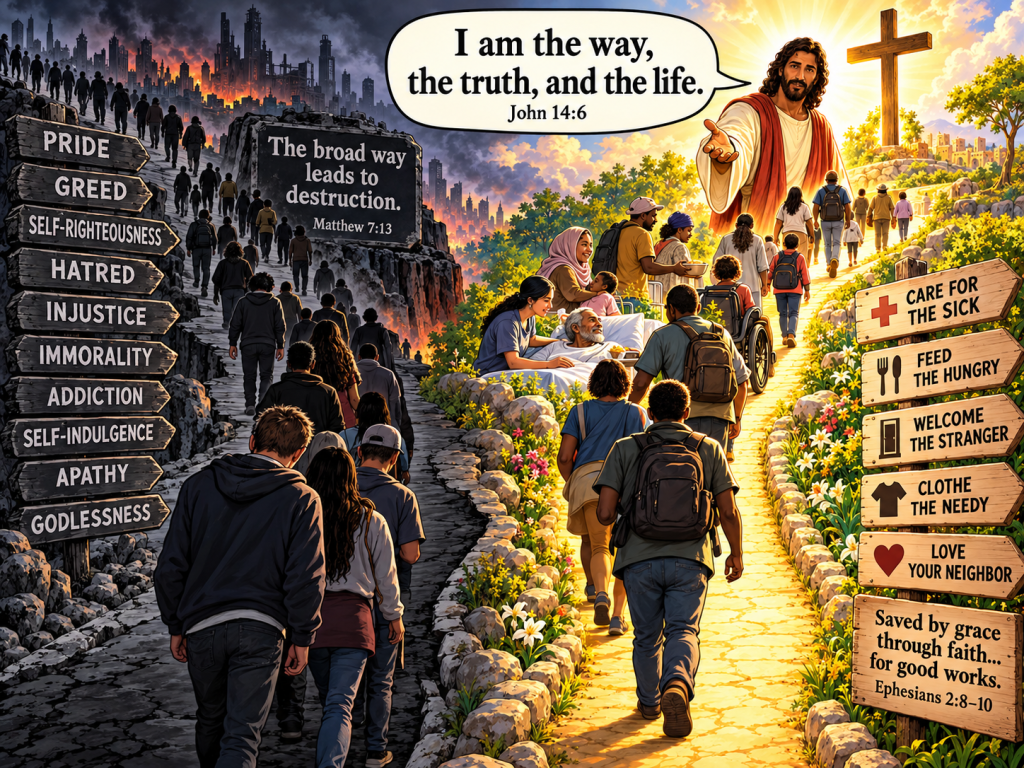
Chatty, could you analyze the image below image and tell me based on the Scriptures how many theological errors you can find?
This is an interesting image to examine theologically! It draws on several biblical themes, especially Matthew 7 and Matthew 25, but I see some significant problems with how it combines them.
I can identify at least 10 potential theological errors or misleading implications, although some depend on whether we interpret the picture literally or as political satire.
The central problem is that the illustration appears to equate political affiliation with spiritual righteousness, while Scripture places salvation, righteousness, and discipleship on a different foundation.
Let’s examine it carefully, using Scripture as our standard rather than either political party.
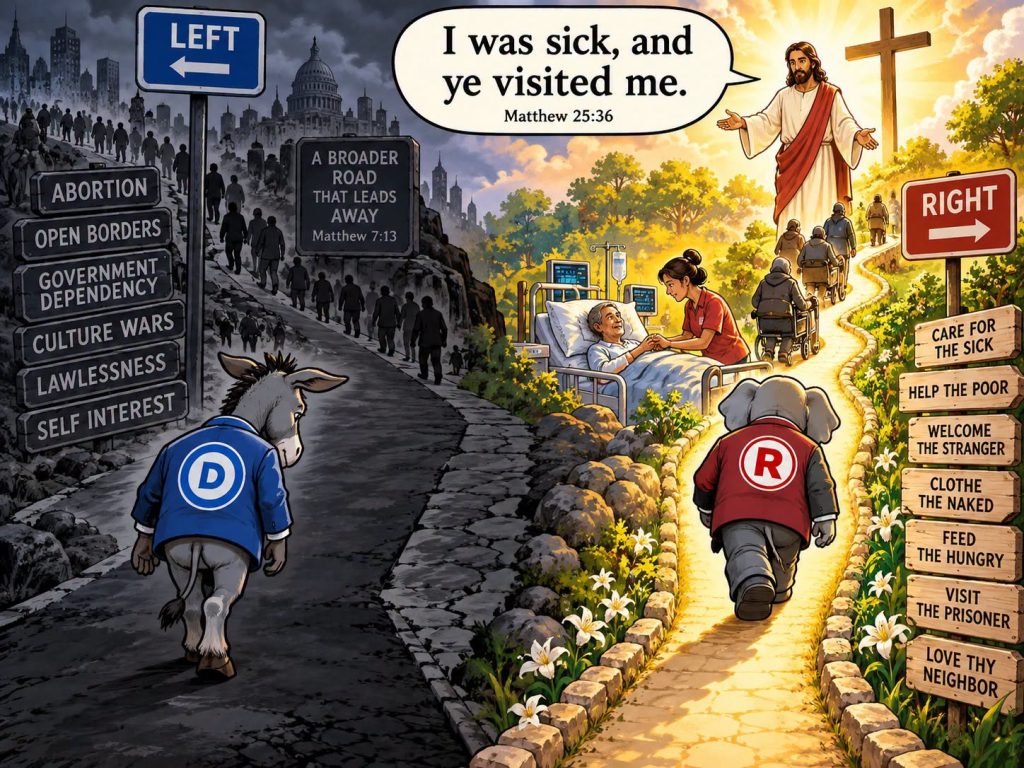
The Democratic donkey walks toward the dark road, while the Republican elephant walks toward the bright road where Jesus stands.
This implies that Republican affiliation leads toward Christ while Democratic affiliation leads away from Him.
1. It suggests that salvation depends on political affiliation
Biblical correction:
- Ephesians 2:8–9 — We are saved by grace through faith, not works.
- Romans 10:9–13 — Salvation is available to everyone who calls upon the Lord.
- Acts 10:34–35 — God shows no partiality.
Neither political party is inherently Christian, and membership in either party establishes nothing about an individual’s salvation.
The right-hand pathway emphasizes feeding the hungry, visiting prisoners, caring for the sick, and other charitable activities.
2. It confuses good works with the basis of salvation
These are certainly biblical commands. But the visual presentation suggests that following these commands is what places someone on the path toward Jesus.
Biblical correction:
- Titus 3:5 — Salvation is not by works of righteousness we have done.
- Ephesians 2:10 — Good works are the result and purpose of our salvation, not its cause.
- James 2:17 — Genuine faith produces good works.
The distinction between salvation by good works and salvation resulting in good works is essential.
3. It misuses Matthew 7:13
The left-hand sign says:
A broader road that leads away — Matthew 7:13
But Jesus spoke of two gates and two ways: the broad way leading to destruction and the narrow way leading to life.
Biblical correction: Matthew 7:13–14 concerns the eternal consequences of entering through the narrow gate, not choosing between contemporary American political platforms.
The image appropriates this passage to condemn an entire political category rather than emphasizing the need for every individual to respond to Christ.
4. It implies Jesus endorses one political party
Jesus stands prominently at the end of the Republican pathway, visually identifying Himself with that party.
Biblical correction:
- John 18:36 — Jesus declares that His kingdom is not of this world.
- John 6:15 — Jesus withdraws when people attempt to make Him king.
- Philippians 3:20 — The Christian’s citizenship is in heaven.
Christ’s teaching has political implications, but no modern political party can claim Him as its exclusive representative.
The left-hand signs include:
- Abortion
- Open borders
- Government dependency
- Culture wars
- Lawlessness
- Self-interest
5. It treats disputed political policies as explicit biblical sins
These are presented together as though Scripture condemns them all in precisely the same way.
Biblical correction:
Scripture addresses some of these issues directly through moral principles, while others involve policy judgments.
For example, Psalm 139:13–16 and Jeremiah 1:5 are important texts in Christian arguments for protecting unborn life. Romans 13:1–4 addresses governmental authority and lawfulness.
But there is no biblical command prohibiting government assistance programs, nor does Scripture prescribe a modern immigration policy.
Deuteronomy 10:18–19 commands Israel to love the foreigner, while 2 Thessalonians 3:10 addresses unwillingness to work.
The theological mistake is treating political policy preferences as if they were all explicit commandments of God.
6. It assigns Christian virtues exclusively to Republicans
The right-hand signs include feeding the hungry, welcoming strangers, caring for the sick, and loving one’s neighbor.
But these are obligations for all Christians, regardless of political affiliation.
Biblical correction:
- Galatians 6:10 — Do good to everyone, especially fellow believers.
- Luke 10:25–37 — The Good Samaritan illustrates love across social and religious boundaries.
- Matthew 5:44 — Love even your enemies.
Interestingly, Jesus chose a Samaritan—someone from a group despised by many of His Jewish listeners—as the positive example of neighborly compassion.
That should caution Christians against identifying righteousness exclusively with their own group.
The picture portrays one political direction as dark and morally deficient and the other as illuminated and righteous.
But Scripture does not divide humanity into politically righteous and politically unrighteous people.
7. It overlooks the universal problem of human sin
Biblical correction:
- Romans 3:10 — None is righteous, no, not one.
- Romans 3:23 — All have sinned and fall short of God’s glory.
- 1 John 1:8 — Claiming to be without sin is self-deception.
Neither Democrats nor Republicans escape the universal need for repentance and forgiveness.
8. It risks replacing allegiance to Christ with tribal loyalty
The donkey and elephant are identified primarily by their political symbols.
One is associated with darkness, the other with Christ.
This creates the impression that political identity determines spiritual identity.
Biblical correction:
In 1 Corinthians 1:12–13, Paul rebukes believers for dividing themselves into factions around particular leaders.
His pointed question is:
Is Christ divided?
The church belongs to Christ, not to an earthly faction.
Political loyalties must remain subordinate to the Christian’s allegiance to Jesus.
9. It overlooks the importance of the heart and genuine faith
On the right, charitable actions are portrayed as evidence of following Christ.
But Scripture distinguishes outward religious behavior from inward faith and genuine love.
Biblical correction:
- Matthew 6:1–4 — Jesus warns against performing righteous deeds to be seen by others.
- 1 Corinthians 13:3 — Giving away everything gains nothing without love.
- 1 Samuel 16:7 — The Lord looks upon the heart.
Someone may perform charitable works for political advantage, public recognition, or genuine compassion.
The outward activity alone cannot establish that someone belongs to Christ.
10. It applies Matthew 25 selectively
This may be the most revealing problem with the image.
At the top, Jesus says:
I was sick, and ye visited me. — Matthew 25:36
On the right, the signs summarize several actions described in Matthew 25:31–46.
But Jesus never associates these works of mercy with a particular political group.
In fact, Matthew 25 depicts the Son of Man separating people as a shepherd separates sheep from goats.
Biblical correction:
Matthew 25:40 teaches that what is done for the least of these brothers of Christ is done for Him.
The passage calls for serious self-examination and practical compassion. Interpretations differ regarding precisely whom “the least of these my brothers” identifies, but nothing in the passage assigns righteousness according to party affiliation.
The image effectively turns Jesus’ teaching into a political endorsement.
11. A final theological concern: the cross
There is also an eleventh potential problem worth mentioning.
The image prominently features a cross beside Jesus, but it gives much more emphasis to political symbolism and acts of charity than to His atoning death and resurrection.
The cross is present visually, but the gospel itself is not clearly explained.
- 1 Corinthians 15:3–4 — Christ died for our sins, was buried, and rose again.
- 1 Peter 3:18 — Christ suffered for sins, the righteous for the unrighteous, to bring us to God.
- John 14:6 — Jesus identifies Himself as the way, the truth, and the life.
The image could be understood as showing the fruit of Christian discipleship rather than explaining salvation. Nevertheless, it is theologically misleading if it substitutes moral or political behavior for faith in Christ.
Summary
| # | Potential theological error | Principal Scripture |
|---|---|---|
| 1 | Political affiliation determines salvation | Ephesians 2:8–9 |
| 2 | Good works are the basis of salvation | Titus 3:5 |
| 3 | Misapplication of the broad and narrow ways | Matthew 7:13–14 |
| 4 | Christ endorses a particular political party | John 18:36 |
| 5 | Political policy preferences equal biblical commandments | Romans 14:1–4 |
| 6 | Christian virtues belong to one political party | Luke 10:25–37 |
| 7 | One political group is inherently righteous | Romans 3:23 |
| 8 | Political loyalty defines Christian identity | 1 Corinthians 1:12–13 |
| 9 | Outward charitable behavior establishes inward faith | 1 Corinthians 13:3 |
| 10 | Matthew 25 is a partisan political judgment | Matthew 25:31–46 |
| 11 | The gospel risks being obscured by political morality | 1 Corinthians 15:3–4 |
My overall assessment
I would distinguish between explicit doctrinal errors and misleading theological implications. Because this is a symbolic political cartoon, we cannot know that its creator intended to teach all eleven propositions literally.
However, the picture’s central theological weakness is substantial: it appears to turn the way of Christ into a choice between American political parties.
And there is a particular irony here.
Matthew 25 should challenge Republicans and Democrats alike. Caring for the vulnerable is not a partisan virtue; it is an obligation of Christian discipleship.
Likewise, Matthew 7 warns all people about the broad road, not merely those whose politics differ from our own.
I think the strongest biblical response to this picture comes from John 14:6:
“I am the way, the truth, and the life: no man comes to the Father, but by me.”
Jesus is the way—not the Republican Party, not the Democratic Party, and not a program of good works.
That, to me, is the fundamental theological distinction this illustration obscures.
Chatty, could you correct the image based on what you outlined above?